Showing posts with label Historic. Show all posts

Thursday, September 19, 2013

Saying Goodbye to an Old Friend: The Barnard WPA Water Tower...1941-2013

Since 1941, at least five generations of Barnard residents and visitors have seen the majestic art deco water tower as the trademark part of the Barnard skyline.  That tower is part of the memory of anyone who has any connection to Barnard, Kansas.  As of September 18th, the tower is becoming a memory.  Demolition started erasing the last significant structure that made Barnard unlike most other communities.

The Barnard WPA water tower was completed in 1941 around the time of the United States' entry into WWII.  It was the visible jewel of the newly installed municipal water system in Barnard.  The tower held 50,000 gallons of water that satisfied the needs of the prospering community.

The tower held another role other than the functional water storage facility.  Barnard's tower quickly became a landmark.  Numerous people returning home or visiting could see the tower miles away and knew they were close to their destination.  Returning soldiers from WWII knew they were close to home when the reinforced concrete tower appeared on the horizon.  Ott Saunders' grandchildren always tried to see which one of them could be first to see Grandpa's water tower.  When they visit Barnard nowadays, they still look for that tower.  The question of "are we there yet?" was clearly answered from miles away by that tower appearing on the skyline.

Barnard's historic art deco tower watched over the town for 72 years.  It was built during the years when prosperity still made its appearance in town.  At that time, Barnard had several hundred residents, groceries stores, banks, drug stores, barber shops, lumberyards, a meat locker, a theater, and a functioning railroad station.  The tower continued its duties as the population and local economy declined.  Gradually, people left and businesses closed.  Vacant buildings were demolished and the downtown business district disappeared along with a significant portion of the residential area.  Barnard died as the tower watched and provided water for those who refused to give up.

When the Barnard water network was attached to the rural water district, the purpose of the tower became redundant.  The pressure provided by the rural water district was more than enough (as we have recently experienced) to provide for the needs of the town.  However, the silent sentry still kept watch over the town.

Even after its fate was decided by a small fraction of Barnard's now tiny population, the water tower kept up its duty.  Within the last year, the water valve to the RWD was left on and the tower filled to its full 50,000 gallon capacity and water flowed from its overflow channel.  The tower did not buckle, it continued to serve just as it had for over 70 years.  During a recent lightening strike, the charge blew out  several pipes in the water network all over town...however, the tower itself was not damaged.  We were told that the tower was near collapse, but even as it is being torn down it is showing its strength, having to be slammed repeatedly by the wrecking ball before a little bit of concrete gives away and falls to the ground near the base of the tower.


I am relatively new to this community and the first time I saw that tower, it left me in awe.  As I learned more about the town, it almost seemed like a glorious tombstone for a once vibrant lady.  However, today...as I drove out of town to go to work, I looked at the tower in my rear view mirror...it seemed more like the image of a kindly old gentleman being beaten to death by the town bullies.  Its height had only been diminished by a fraction but it was less prominent on the horizon.  What will replace it will be absurdly mundane.  Where this tower was immediately recognizable as Barnard's, the new one will be a metal tube like thousands of metal tubes just like it scattered across the United States.  You will only be able to tell it is Barnard's because BARNARD will be painted on the side.  Since it is smaller, by the time you can see the print, you will already be in town.  It will be non-descript and like the town...many people will not even realize it is there.

Saturday, February 16, 2013

Old Phones...Old Phone Numbers...

The telephone has been a useful gadget.  I look over at the phone in my office at the old Saunders’ place and I have to chuckle.  That phone was made in 1930 with a little sign in the middle of the dial that says “Please Answer Promptly.”  But if I don’t, the answering machine in the living room will pick up for me.  It is kind of a clash of technology, isn’t it?  That 83 year old phone still works and has better sound than the ones you can buy currently and its ringer box can still wake the dead.
Dialing that old rotary phone brings back some memories.  Yes, though I am only 41 years old, I have memories of dialing phones.  I grew up in the country where we were on a party line…no, I don’t mean a 1-900 number that charges you $4.95 per minute to meet singles in your area…I mean a line that several households shared.  Our party line operated on the honor system…you had to wait for the operator to come on after you dialed the number you were calling so you could give your number so they knew who to charge.  Some weren’t so honorable.  A neighbor boy kept giving the operator our number.  I guess he thought he wouldn’t get caught.
Phones have become much more convenient.  A cell phone fits in my pocket and I can be reached just about any place I could go…my cell number used to be my grandparents’ number at the farm so my number has been in the family for over 50 years.  Cell phones have brought with them the expectation that you will get someone every time you call them.  Wrong.  I have the philosophy of “just because I carry it with me, doesn’t mean I have to answer it when it rings.”  However, when all is said and done…I still prefer using that 1930 Western Electric.  That old handset is heavy enough that it could do some damage if I really wanted to reach out and touch someone <smile>.
A while back, I discovered a stack of old phone books from 1958 when I was looking through the old telephone office in Barnard.  It is very interesting to flip through one of them.  I don’t think you would get Bill or Charlene Watson by dialing “12” and dialing “30” won’t get you connected to the Ott Saunders place.  The Barnard High School phones have been silent for years now, but that number was “88.”
Below are the Barnard pages of the 1958 phone book issued by the United Telephone Company of Kansas.


Saturday, October 6, 2012

More Pictures From The Barnard United Methodist Church's 130th Celebration

Submitted by Jan Dowlin


Barnard Bee Wedding Announcements...1902

24 April 1902

Mr. Edgar Baker and Miss Lillian Hawkins were married at the home of the bride's parents, one mile north of Lincoln, last week. Mr. Baker is a son of Representative Baker, and is one of the proprietors of the Lincoln Sentinel.

8 May 1902

Judge VanNetta united in the holy bonds of wed-lock, C. L. Rees, son of Dr. John Rees, and Miss Pearl Brockway, one of Mitchell county's school teachers, at Beloit Monday, April 28th.
The many friends of these young people will congratulate them in their happiness. They were both raised in this vicinity, and are highly respected by all who know them. Here's the best wishes of the Bee.

5 June 1902

At Barnard, Ks, May 30, 1902, Annie L. Parsons, to John H. Hood, Rev. E.B. Wells officiating.
Miss Parsons is the daughter of Chas. Parsons, a well-to-do farmer, five miles south west of town. She is well known and highly popular. Mr. Hood is a young man well spoken of, who has spent the last few years in this vicinity. His home is in Simpson. Here's congratulations of the Bee.

17 July 1902

Marion Crowl and Mrs. Martha Bushong went over to Lincoln Tuesday and were married. They returned quite late that same evening, which face saved them from being the victims of a charivari, as quite a number of the friends of both had gathered for that purpose, but after waiting until they were tired out they dispersed.
The contracting parties are so well and favorably known that nothing that we can say will add to their popularity. They have both resided in this community a number of years and have a host of friends whom the Bee joins in wishing them much happiness and a long life.

7 August 1902

When Miss Alice Joseph and her sister Mrs. O. J. Perkins went to Hutchinson last week their Barnard friends little thought that a wedding was in view. But such was the case.
As most of our Barnard readers know, Mr. VeRon has been engaged in theatrical work since leaving Barnard, and the nature of the work is such that he could not leave his company, so arrangements were made to meet at Hutchinson where Miss Alice had relatives.
The ceremony was performed August 1st that made them one, and the happy couple are the recipients of teh congratulations of their many friends.
Miss Joseph is the daughter of John Joseph, formerly of this place, but now located at Gibbon, Oklahoma. She is a particularly accomplished young woman with a host of admiring friends in this vicinity who have known her from childhood.
Mr VeRon is not only an able man in his chosen profession, but a good printer, and while he was connected with this paper made many friends in Barnard who will congratulate him in his new life.

20 November 1902

Just as we go to press we learn that Al Wright, of Elkhorn district, and Miss Lulu, daughter of Abe King, were married Wednesday at Lincoln. The Bee congratulates.

27 November 1902

At the residence of the bride's parents in Milo, Kan., Wednesday, Nov. 26, 1902, at 6 o'clock a. m., Annie E., the only daughter of Mr. and Mrs. Geo. R White, Elder H. R. Gouldin officiating.
That's why the editor of this paper rose so early yesterday morning -- four o'clock; we went to the wedding.
We found the White home well filled with friends and relatives of the contracting parties. Promptly at six o'clock that patriarch of parsons, Elder Gouldin began the ceremony that was to unite two loving hearts for life. The beautiful ceremony was soon over and the guests sat down to the splendid wedding breakfast that had been prepared.
The bride was gowned in white silk, trimmed with white applique, all beautifully set off with white chrysanthemums tied with white ribbon. Later she appeared in a traveling dress, an exceedingly neat conception of the tailor-made art.
The groom was dressed in conventional black and made a model looking benedict in every way.
The bride, as Annie White was loved by all her associates. As Mrs. Howard Wright she will know a greater love – her husband's.
It was a happy wedding, the kind we like to see – no "solemncholy" about it; everybody seemed to be thoroughly happy.
Many and beautiful were the tokens of love presented by admiring friends.
At about 8:15 the newly wedded couple took the train for Denver. From there they go to Las Vegas, New Mex., thence to Ft. Worth, Texas. Will return in about two weeks to Howard's home near Milo. The Bee wishes them a pleasant trip and safe return.
And thus is recorded another chapter in the history of two counties.
Howard W. Wright was the first white child born in Ottawa county, Kans., date of his birth being May 17, 1860. His father, the late S. M. Wright, and mother (maiden name Elizabeth Humbarger) located on Pipe creek one mile north of where Minneapolis now stands in the fall of '58 where they built a log cabin. It was nearly two years later that Howard came to brighten the lives of the daring young couple who were not afraid to brave the dangers and hardships of frontier life.
The family moved to Lincoln county in 1869, locating on 2d creek, 3½ miles northeast of where Milo now stands.
In the days of Howard's early childhood, buffalo and Indians were to be seen on every hand. The nearest neighbor, Gus Marvek, lived 12 miles away. Marvek was quite a genius in his way – a natural artist with the brush; but as a cook he would hardly pass in an up to date cafe – he insisted on using gray wolf lard for short'ning.
These pioneers went to mill at Junction City, about 65 miles distant, by ox team, a long and arduous trip.
In 1863 the Cheyenne and Pawnee Indians burned the grass along the Solomon river in order to drive the buffaloes south for the winter. For three days and nights the thunder of the thousands of hoofs was heard as they passed the Wright claim in vast herds. The day after the stampede fifteen carcases [sic] were found where they had run over the banks of Pipe creek. Their eyes had been burnt out by the fire, and in agony and fear they had unwittingly gone to their death in the creek.
On one occasion when Howard was about six years old a party of drunken Indians came to the Wright cabin and ran things to suit themselves. The little paleface-papoose was a great curiosity to them, and they amused themselves by holding him up by the heels, the terrified mother expecting to see her darling baby killed any minute. The Indians finally tired of their sport and went away, but they stole all of Howard's clothes when they went.
Howard lived in Kansas until he was 21, when he went on the range in No Man's Land, where he remained five years. From there he went to New Mexico and Arizona, where he saw some stirring times while engaged in the cattle business. He says it was almost a continual fight with the thieving greasers. He then went to Colorado where he spent some ten years in the same business.
He returned to the old home near Milo last fall because of his father's death, so that he might take care of his mother who is 71 years old.
Twenty-five years of rough life on the plains and cattle range has given Howard a rugged constitution and splendid physique. He has been highly successful in the cattle business, and today is one of our most substantial and most respected citizens. It’s the hope of all that he and his estimable wife may never be tempted to leave our midst.

18 December 1902

On Dec. 16, at the residence of the bride's parents in Barnard, by Rev. H.R. Gouldin, Mabel Sharp to Archie J. Brockway.
The bride is the adopted daughter of Mr. and Mrs. Wm Snapp; the groom is a prosperous young farmer living on Fourth creek.
We have not the pleasure of an acquaintance with these young people, but hear nothing but good words for them. We understand they are both native Kansans, and that of itself is a guaranty of merit. Here's the Bee's best wishes.


These marriages were gleaned by Craig Trost and retrieved from http://skyways.lib.ks.us/genweb/lincoln/barnardmarriages.htm

Tuesday, August 7, 2012

Barnard Census Numbers

Census numbers for Barnard...

1910     425 people
1920     unavailable
1930     416 people
1940     306 people
1950     242 people
1960     unavailable
1970     unavailable
1980     unavailable
1990     129 people
2000     123 people
2010       70 people

Figures courtesy of the Lincoln County Historical Society and the U.S. Census Bureau

Wednesday, August 1, 2012

A Barnard Resident's Story...The Obituary of Otto Saunders

A town's story can be told through the obituaries of its residents...

Otto Saunders

Otto Saunders was born July 29, 1899, in Lincoln to Flint and Elizabeth (O'Neill) Saunders and passed away on Feb. 24, 1983, at the Ottawa County Hospital, Minneapolis, at the age of 83 years, six months, and 26 days.

Ott and Eva Loy were united in marriage Sept. 25, 1921 and this union was blessed with five children.  They lived most of their life in Barnard and celebrated their 61st wedding anniversary last September.

Ott and Eva had an ice business for many years, and in the late '40s, he became a city councilman for Barnard, and a year later, became city marshal.  Ott was also Lincoln County Deputy Sheriff until his death, and was both fire chief and water and sewer superintendent for Barnard.  Ott helped build the water tower, sewer, and dike and retired a year ago after 35 years of service to the city.

Ott and Eva both enjoyed fishing and he loved fishing from the boar especially.  He would go out and get crawdads when he could hardly walk, just to have on hand in case someone came along wanteing to go fishing.  He loved his grandchildren and great-grandchildren and when any of them came into town they would argue over who saw Grandpa's water tower first and still think it is Grandpa's.

Ott is survived by his wife Eva, of the home; five children:  Dale of Salina, Pete of Minneapolis, Beth (Mrs. Leroy Holcom) of Gypsum, Jerry of Dodge City, and Peggy (Mrs. Norris Herbel) of Barnard; four brothers, Melvin, Colton, Calif.; Alfred, McPherson; Ludwell, Yucaipa, Calif.; and Donald, San Bernadino, Calif.; two sisters, Mrs. Ethel Smith, Salina, and Mrs. Helen Crawford, Derby; 19 grandchildren and 12 great-grandchildren.

Services were held Feb. 26, 1983, at the Hall Memorial Chapel.  Burial was in the Milo Cemetery, Barnard.


From:

Lincoln Sentinel-Republican, 17 March 1983
Lincoln County Historical Society Obituary Archive

Tuesday, July 31, 2012

A Field Trip to the Lincoln County Historical Society

Today, I took a field trip to the Lincoln County Historical Society.  Andrew  Anderson introduced himself at the fair when he came by the Barnard Banter booth and invited me to stop by.  The visit was well worth my while and more visits are going to be made so that I can see more.  The museum has a fairly extensive collection on Barnard.  These are only a few items in the Barnard collection.


Sunday, July 29, 2012

A Betty's Place Memory From the Fair

One of the people that stopped by the Barnard Banter booth at the fair had a Betty's Place memory to share.  He shared that he lived a little ways west of Barnard and used to work for the state.  He recounted how the state guys used to argue over who got to drive the trucks into Barnard.  If they drove the morning trucks in, they made it a point to stop in for Betty's cinnamon rolls.  If they drove in around lunch time, they got some of Betty's chicken. 

Since I've been involved with the Barnard community, many have told me how legendary Betty's Place was.  You can still find some reviews from national publications online.  Betty's Place has been closed for a while, but it made quite an impression on people.

Sunday, July 1, 2012

Barnard Photo Postcards submitted by Judy Prater

Three miles west of Barnard in 1984.

Betty Loy's "Betty's Place."

East side of Main Street in 1984.

West side of Main Street in 1984.

First Baptist Church in Barnard.

First Methodist Church in Barnard.

The old community building.

Barnard post rock.

Barnard's Art Deco water tower.

Monday, June 11, 2012

Barnard Bee Excerpt from May 5, 1938

I spent the afternoon looking through several years of Barnard Bee articles.  This is a capture from the May 5, 1938 edition.  There is a larger Barnard Bee spread on the way in the near future.


Sunday, June 10, 2012

Update on the Water Tower

The City of Barnard and the Kansas State Historical Society have entered the phase of signing off on the demolition of the historic water tower.  However, the firm that the city hired to do the work gave a cost estimate to preserve the water tower.

The cost that Schwab-Eaton gave to repair the water tower for use as a non-functioning landmark is $65,000.  There would be an additional cost of $2,500 per year to pay for maintenance every 10 years.  The city government doesn't even have to take part.

We could save our water tower, which is the only structure that keeps us from looking like every other town in the area, for only $65,000 initially with an additional investment of $2,500 per year?  Wow!  It sounds like a bargain to me in order to save our heritage.  There are grants that could take care of this cost.  Even if we only received a matching grant, it would only cost us $32,500.

I'll remember this when someday I have to answer a question about the water tower and send someone 80 miles away to Mahaska so they can see what we let go.  We could save it for $65,000.

By the way, the cost of the new one is over a quarter of a million dollars.  The absurdity of this situation...priceless.

Monday, June 4, 2012

The Town That Couldn't Survive

Milo fell victim to the railroad.  The placement of the station could make or break a town.  Milo tried relocating to survive...it didn't work.  All that is left is the cemetery (at its first location) about 4 miles outside of Barnard.

Palmetto Inn in Barnard

From a postcard postmarked 1917.

An Early Photo of the Barnard Methodist Church

Friday, June 1, 2012

Barnard Post Office History


"Barnard Post Office established 100 years ago"
From the Lincoln Sentinel-Republican, May 20, 1982
 

It’s centennial time at the Barnard Post Office next week, reports Postmaster Marjorie Maholland. Cake and coffee will be served patrons and friends in an all-day open house Friday, May 21, in observance of the insitution’s 100th year.

Doing a bit of research on her own, Mrs. Maholland learned that it was 100 years ago May 18, 1882, that the first United States Post Office was established at Nimrod, with Isaac A. Ballard as its postmaster. Six years and four days later, May 22, 1888, the federal government changed the site to Barnard and named William A. Smith postmaster.

According to Mrs. Maholland, this information was verified by the U.S. Postal Service, Bureau of Archives, Washington, D.C., just a few days ago in answer to her inquiry.

Today, the Barnard Post Office serves 76 customer-patrons at its window and inside boxes; there are 124 rural route patrons. In addition to the postmaster, the staff includes Virginia Montgomery, clerk; Bill Biggs, rural carrier; and Leo Wallace, substitute carrier.

Mrs. Maholland, who has been Postmaster since 1976, said that the present native stone building housing the postal service at Barnard was built in 1960. The Barnard Post Office has been situated in several different bildings in various locations since it was established a century ago.

Source:  http://skyways.lib.ks.us/genweb/lincoln/barnard2.htm

The Founding of Barnard


The Founding
of
Barnard


From the Lincoln Beacon, Sept. 22, 1887

 
The new town of Barnard was partly surveyed and laid off in lots last week. All of the town now surveyed is in Scott township, in the southeast quarter of section 12, and the northeast quarter of section 13, on the I.A. Ballard and Davis King farms. It is now owned or controlled by the Kaw Valley Town Co., so we understand. We learn that they have fixed the price of lots from $60 to $300.

Loy’s addition is in the northwest quarter of section 18, in Salt Creek township, directly east and on the same kind of land, and only a short distance from the railroad station where now located. He expects to have it surveyed this week, and offers to sell lots for from $20 to $60 per lot.

This is business and we hope that all who contemplate locating in the new town of Barnard will take advantage of Mr. Loy’s more liberal terms. Let everyone in the township of Salt Creek take hold and help boom their own side of the town, as we have no need of going outside of the township to do business.

Source:  http://skyways.lib.ks.us/genweb/lincoln/barnard1.htm

Friday, April 6, 2012

The Historic Barnard Water Tower Receives Visitors on Friday, April 6th


The Barnard water tower received a great deal of attention today from a varied group of people there to determine its future.  In attendance were Patrick Zollner, Division Director of Cultural Resources for the Kansas State Historical Society;  Kim Gant, Review and Compliance Coordinator for the KSHS; Travis Zirkle of Barnard, Incorporated; Joan Nothern, Board Member of the Kansas Preservation Alliance and the Glasco Foundation; Doug McKinney, Executive Director of the North Central Regional Planning Commission; John Cashatt of Schwab-Eaton Civil Engineering; Barb Rathbun, City Clerk of Barnard; and Nancy Houghton of the Barnard city council.

Travis Zirkle of Barnard, Incorporated had contacted Patrick Zollner to arrange for a site visit to the Barnard water tower.  The fate of the current historic WPA built Art Deco water tower has been uncertain since the city embarked on a project to build a new standpipe that would require the demolition of the current landmark tower.

The group in attendance represented those that want to see the old tower preserved after the new one is constructed, those that want the landmark tower torn down, and those that must review the project and make the decision.

There was a great deal of discussion.  Though there wasn’t agreement on what the outcome would be, there was an enormous amount of information shared and genuine communication between the different organizations present.  John Cashatt of Schwab-Eaton did dispute that any concrete could make it to neighboring properties by falling off the tower.

Recently, Barnard, Incorporated made a request to the Kansas State Historical Society and HUD to be a consulting party involved in the project under the Section 106 process.  The Section 106 process is used to review all federally funded or permitted projects for their impact on cultural resources.  The grant that was approved for the new water standpipe project is funded by federal dollars.  The remaining $108,000 is the responsibility of the City of Barnard.  Bonds are being sold to meet that obligation.


Monday, March 26, 2012

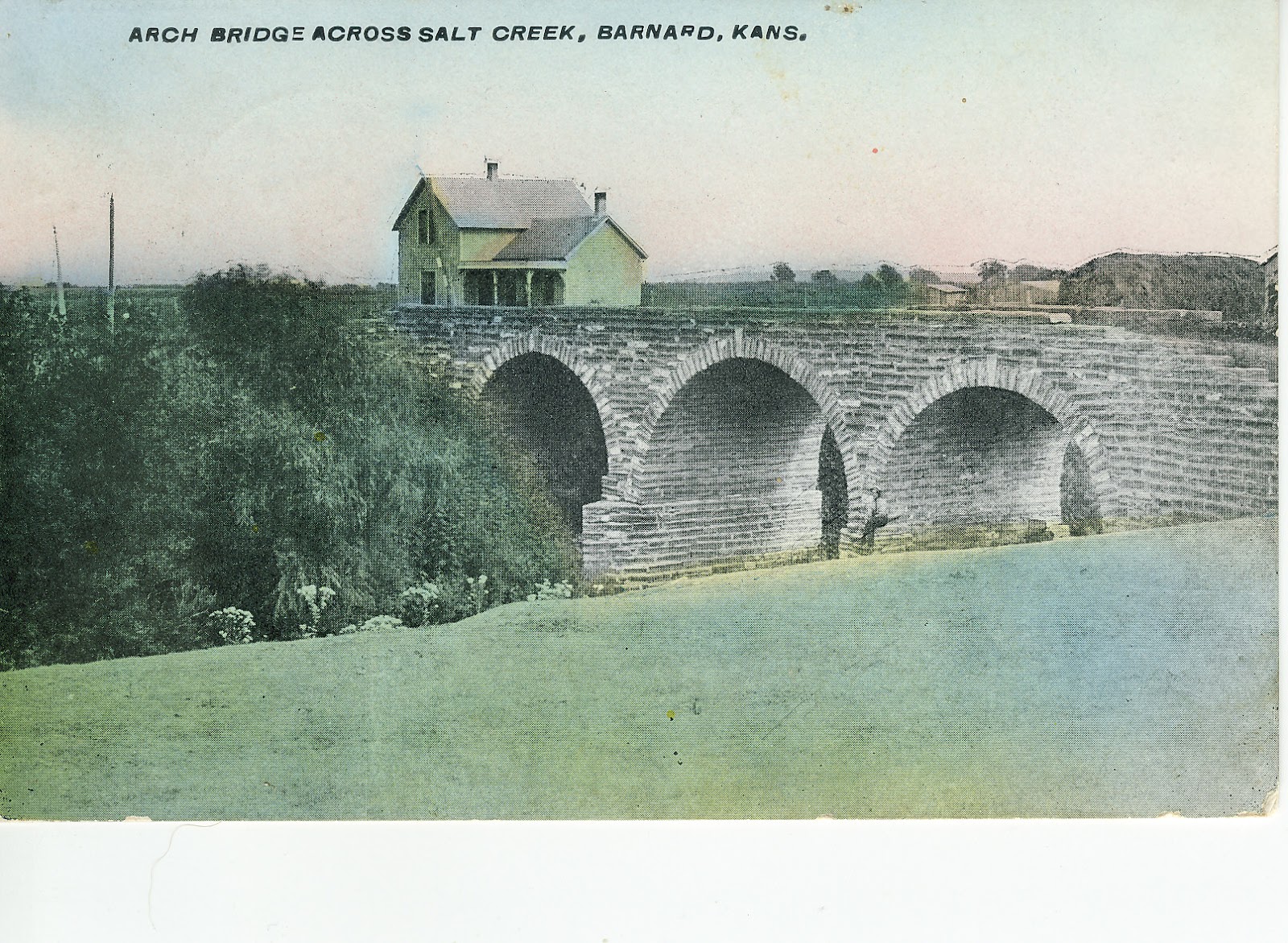
Post Card From the Past...Stone Arch Bridge on the East Edge of Town

This bridge has been gone for quite some time.  It actually collapsed as Bob Wallace was driving across it in April of 1929.

Also, if you know anything about the person who wrote or the person who received this postcard, I am interested in knowing.  Email at barnardbanter@aol.com.


Friday, March 16, 2012

A Research Project...

In addition to the water tower preservation project, I am conducting some research into the beginnings of Barnard.  I am trying to locate the location of the first building in Barnard.  It was built by G.W. Snapp for Ross Wilcox, the manager of the lumberyard.  In 1908, the residence was occupied by George Hiserote and family.

If you have any information about this structure, please let me know at barnardbanter@aol.com.